Green Hydrogen Storage Comparison Guide: Insights, Basics, Facts & Practical Knowledge
Green hydrogen storage refers to the methods used to store hydrogen produced through renewable energy sources such as solar and wind via electrolysis. As hydrogen gains attention as a clean energy carrier, storage has become a critical component of the value chain. Unlike fossil fuels, hydrogen has a low volumetric energy density, making efficient storage both technically and economically challenging.
This comparison matters increasingly in recent years due to the global push toward decarbonization and net-zero targets. Governments and industries are investing heavily in hydrogen infrastructure, but storage remains a bottleneck affecting scalability and cost. The choice of storage method directly impacts transportation feasibility, safety, and end-use applications.
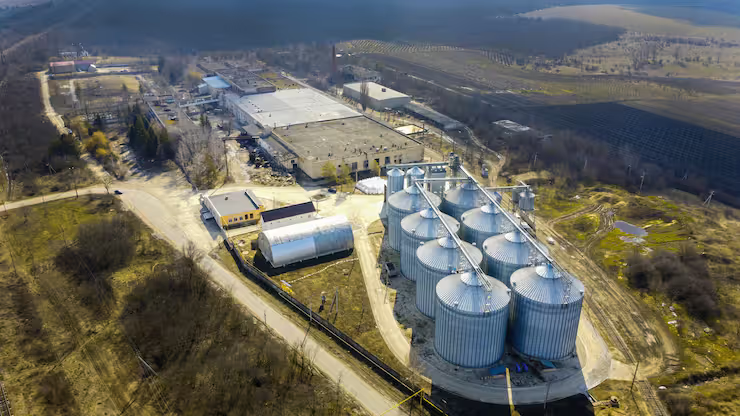
Recent trends show rapid advancements in compressed gas storage, liquefied hydrogen, and emerging solutions such as solid-state storage and chemical carriers like ammonia. According to industry analyses, storage can account for a significant portion of hydrogen supply chain costs, emphasizing the need for optimized solutions. As deployment accelerates, understanding these storage methods is essential for policymakers, engineers, and stakeholders navigating the evolving hydrogen economy.
Who It Affects and What Problems It Solves
Green hydrogen storage affects a wide range of sectors including energy producers, transportation industries, heavy manufacturing (such as steel and cement), and power grid operators. Governments and policymakers are also directly involved, as infrastructure planning and regulatory frameworks depend on storage capabilities. For businesses investing in hydrogen, storage decisions influence capital expenditure, operational efficiency, and long-term sustainability outcomes.
End users such as fuel cell vehicle operators, renewable energy developers, and industrial users rely on stable hydrogen supply. Without efficient storage, renewable hydrogen production cannot align with demand cycles, particularly because solar and wind energy are intermittent.
Problems It Solves
- Energy intermittency: Storage enables excess renewable energy to be converted into hydrogen and used later.
- Transport limitations: Efficient storage methods allow hydrogen to be transported over long distances.
- Grid balancing: Hydrogen storage acts as a buffer for power systems with high renewable penetration.
- Industrial decarbonization: Provides a consistent fuel source for hard-to-abate sectors.
- Energy security: Reduces dependence on fossil fuel imports by enabling local energy storage.
Recent Updates and Trends
Over the past year, green hydrogen storage has seen notable developments:
- Scaling of liquefied hydrogen projects: Several pilot plants globally have expanded capacity, aiming to reduce liquefaction costs and energy losses.
- Ammonia as a carrier: Increased investment in ammonia-based hydrogen transport, particularly for export markets like Asia and Europe.
- Solid-state research advancements: Metal hydrides and novel materials are being tested for safer, high-density storage.
- Infrastructure funding: Governments in regions such as the EU, India, and the US have introduced incentives for hydrogen hubs and storage facilities.
- Cost reduction focus: Efforts are ongoing to improve compression efficiency and reduce boil-off losses in liquid hydrogen systems.
These trends highlight a shift from experimental phases toward commercialization, although technological maturity varies across storage types.
Comparison of Green Hydrogen Storage Methods
| Storage Method | Description | Advantages | Limitations | Typical Use Cases |
|---|---|---|---|---|
| Compressed Gas | Hydrogen stored under high pressure (350–700 bar) | Mature technology, relatively simple systems | Low energy density, high compression energy | Vehicles, small-scale storage |
| Liquefied Hydrogen | Hydrogen cooled to -253°C | Higher energy density than gas | Energy-intensive liquefaction, boil-off losses | Aerospace, long-distance transport |
| Metal Hydrides | Hydrogen absorbed into solid materials | High safety, compact storage | Heavy materials, slow release rates | Stationary storage, niche uses |
| Chemical Carriers | Hydrogen stored in compounds like ammonia | Easier transport, existing infrastructure | Conversion losses, additional processing required | International shipping, industry |
| Underground Storage | Stored in caverns or depleted reservoirs | Large-scale, cost-effective for bulk storage | Location-specific, geological constraints | Grid storage, seasonal storage |
Laws and Policies Impacting Green Hydrogen Storage
Green hydrogen storage is shaped by evolving regulatory frameworks across different countries. Policies typically address safety, infrastructure development, and environmental standards.
- India: The National Green Hydrogen Mission emphasizes domestic production and infrastructure, including storage systems. Incentives are provided for pilot projects and scaling technologies.
- European Union: Hydrogen strategy includes funding for storage innovation and cross-border transport infrastructure.
- United States: Hydrogen hubs initiative supports integrated systems including production, storage, and distribution.
Practical Guidance
- Compressed gas storage is often suitable for early-stage or small-scale projects due to regulatory clarity and existing standards.
- Liquefied hydrogen is more viable where long-distance transport or high-density storage is required, but compliance with safety regulations is stricter.
- Underground storage is ideal for large-scale energy systems, but requires geological approvals and environmental assessments.
- Chemical carriers are practical for international trade scenarios where shipping infrastructure already exists.
Organizations must align storage choices with local regulations, safety codes, and long-term policy incentives to ensure compliance and financial viability.
Tools and Resources
Several tools and platforms can support decision-making and analysis in green hydrogen storage:
- HOMER Energy – Simulation software for renewable energy systems including hydrogen integration
- HyCalc – Hydrogen cost and performance calculator tools
- IEA Hydrogen Reports – Data-driven insights and global benchmarks
- NREL Models – Technical and economic modeling tools for hydrogen systems
- Hydrogen Europe Resources – Policy updates and industry research
- Open-source LCA tools – For lifecycle analysis of storage technologies
- Energy system optimization platforms – For grid and storage planning
These resources help stakeholders evaluate cost, efficiency, and environmental impact before selecting storage methods.
Frequently Asked Questions (FAQ)
What is the most efficient way to store green hydrogen?
Efficiency depends on use case. Compressed gas is widely used, while underground storage is most efficient for large-scale applications.
Why is hydrogen storage challenging?
Hydrogen has low density and requires high pressure or low temperatures, increasing cost and complexity.
Is liquid hydrogen better than compressed gas?
Liquid hydrogen offers higher density but requires significant energy for cooling, making it suitable for specific applications.
Can hydrogen be stored long-term?
Yes, especially in underground storage systems, which can store hydrogen seasonally with minimal losses.
What role do chemical carriers play?
They enable easier transport and storage by converting hydrogen into more stable compounds like ammonia.
Conclusion
Green hydrogen storage is a critical enabler of the clean energy transition, but no single solution fits all scenarios. Compressed gas remains the most mature and accessible method, while liquefied hydrogen and chemical carriers offer advantages for transport and higher density applications. Emerging technologies like solid-state storage show promise but are still developing.
Data and industry trends indicate that large-scale deployment will likely rely on a combination of storage methods tailored to specific use cases. For example, underground storage may dominate grid-scale applications, while ammonia-based carriers could support international trade.
The most practical approach is context-driven: choose storage based on scale, location, cost constraints, and regulatory environment. As technology advances and costs decline, hybrid storage strategies are expected to become standard, supporting a more flexible and resilient hydrogen economy.