Electric Vehicle Platform Design Comparison Guide: Insights, Basics, and Technical Overview
Electric Vehicle (EV) platform design refers to the structural and engineering foundation on which electric vehicles are built. Unlike traditional internal combustion engine (ICE) vehicles, EV platforms are designed around batteries, electric motors, and power electronics. These platforms determine key attributes such as vehicle range, performance, safety, manufacturing efficiency, and scalability.
In recent years, EV platform design has become a central focus for automakers and technology companies due to the rapid global shift toward electrification. Governments are pushing stricter emission regulations, while consumers increasingly demand energy-efficient and technologically advanced vehicles. As a result, manufacturers are investing heavily in dedicated EV architectures rather than adapting existing ICE platforms.
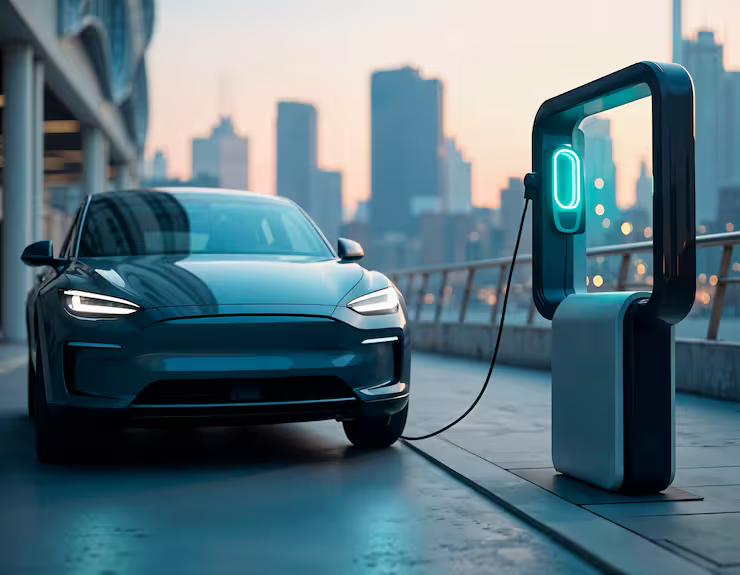
Trends such as “skateboard platforms,” modular battery systems, and software-defined vehicle architectures are reshaping the automotive industry. Companies are optimizing platforms to support multiple vehicle types—from compact cars to SUVs—on a single base. This evolution reduces production costs and accelerates innovation. Understanding these platform designs is essential for engineers, policymakers, and consumers who want to evaluate the future of transportation and its broader environmental and economic impact.
Who It Affects and What Problems It Solves
Electric vehicle platform design affects a wide range of stakeholders including automakers, suppliers, policymakers, urban planners, and end consumers. For manufacturers, platform efficiency directly impacts production cost, scalability, and time-to-market. A well-designed EV platform allows companies to produce multiple models using shared components, improving economies of scale.
Consumers are influenced through factors like driving range, charging speed, cabin space, and safety. For example, dedicated EV platforms often provide better interior space because they eliminate bulky engine components. Fleet operators and logistics companies also benefit from optimized platforms that improve durability and reduce operating costs.
From a broader perspective, EV platforms play a role in national energy strategies and environmental policies. Governments rely on scalable EV designs to meet emission reduction targets and reduce dependency on fossil fuels.
Problems It Solves
- Inefficient energy usage: EV platforms are optimized for energy efficiency, improving range per charge.
- Limited scalability: Modular platforms enable multiple vehicle types on one architecture.
- High manufacturing costs: Standardized components reduce production complexity.
- Space constraints in traditional vehicles: EV platforms allow better interior design and storage.
- Environmental impact: Supports transition to low-emission transportation systems.
Recent Updates and Industry Trends
Over the past year, EV platform design has seen rapid advancements driven by competition and technological innovation.
- Next-generation battery integration: Automakers are shifting toward structural battery packs, where the battery becomes part of the vehicle’s frame. This reduces weight and increases rigidity.
- 800V electrical architectures: More manufacturers are adopting high-voltage systems to enable ultra-fast charging and improved efficiency.
- Software-defined platforms: Vehicles are increasingly built with centralized computing systems, allowing over-the-air updates and advanced driver assistance features.
- Platform consolidation: Companies are reducing the number of platforms they use, focusing on fewer but more flexible architectures.
- Emerging market expansion: Countries like India are investing in localized EV platforms to reduce costs and increase adoption.
Additionally, partnerships between automakers and technology firms are accelerating innovation in battery chemistry, thermal management, and lightweight materials.
Comparison of Electric Vehicle Platform Types
| Feature | Dedicated EV Platform (Skateboard) | Modified ICE Platform | Modular EV Platform |
|---|---|---|---|
| Design Purpose | Built exclusively for EVs | Adapted from ICE | Flexible multi-model |
| Battery Placement | Flat, under floor | Compromised layout | Configurable |
| Interior Space | Maximized | Limited | Moderate to high |
| Manufacturing Efficiency | High | Lower | High |
| Cost Efficiency | High in long term | Lower initially | Balanced |
| Performance Optimization | Excellent | Limited | Good |
| Scalability | High | Low | Very high |
| Development Time | Longer initial | Faster initial | Moderate |
| Safety Integration | Advanced | Moderate | Advanced |
This comparison highlights how dedicated EV platforms provide superior long-term benefits, while modular platforms offer flexibility for manufacturers transitioning gradually.
Laws and Policies Affecting EV Platform Design
Electric vehicle platform development is strongly influenced by government regulations, safety standards, and environmental policies.
Key Regulatory Factors
- Emission Norms: Countries are tightening emission standards, pushing automakers toward zero-emission platforms.
- Battery Safety Regulations: Standards for thermal management, crash safety, and recycling are becoming stricter.
- Localization Policies: Governments encourage local manufacturing of EV components to reduce import dependency.
- Incentive Programs: Subsidies and tax benefits promote adoption of EVs built on efficient platforms.
Practical Guidance
- For manufacturers: Investing in modular and scalable platforms helps meet diverse regulatory requirements across regions.
- For policymakers: Supporting standardization can reduce costs and improve interoperability.
- For businesses: Choosing vehicles built on advanced EV platforms ensures compliance with future regulations and reduces long-term operational risks.
In countries like India, government initiatives such as EV subsidies and production-linked incentives are encouraging domestic platform development.
Tools and Resources
Several tools and resources support the design, analysis, and evaluation of EV platforms:
Engineering and Simulation Tools
- CAD and CAE software for structural design and simulation
- Battery management system (BMS) modeling tools
- Thermal simulation platforms
Data and Analysis Resources
- Industry research reports on EV adoption trends
- Open datasets on battery performance and efficiency
- Lifecycle assessment tools for environmental impact
Development Frameworks
- Modular design templates for EV architectures
- Software platforms for vehicle control systems
- Digital twin technology for real-time performance monitoring
Educational Resources
- Online courses on EV engineering and battery systems
- Technical whitepapers from automotive research institutions
- Government publications on EV policies and standards
These resources help engineers and decision-makers optimize platform performance and align with industry trends.
Frequently Asked Questions (FAQ)
What is an electric vehicle platform?
An EV platform is the structural and technological base of an electric vehicle, integrating batteries, motors, and electronics into a unified system.
Why are dedicated EV platforms better than modified ones?
Dedicated platforms are designed specifically for electric vehicles, offering better efficiency, space utilization, and performance compared to modified ICE platforms.
What is a skateboard platform in EVs?
A skateboard platform places the battery flat under the vehicle floor, creating a low center of gravity and maximizing interior space.
How do EV platforms affect vehicle range?
Platform design influences battery capacity, weight distribution, and aerodynamics, all of which directly impact driving range.
Are modular EV platforms the future?
Yes, modular platforms allow manufacturers to build multiple vehicle types efficiently, making them a key trend in the EV industry.
Conclusion
Electric vehicle platform design is a foundational element shaping the future of transportation. Dedicated EV platforms provide superior efficiency, safety, and scalability, making them the preferred choice for long-term innovation. Modular platforms offer flexibility, enabling manufacturers to adapt quickly to changing market demands and regulatory environments.
Data from industry trends shows a clear shift toward fewer, more versatile platforms that integrate advanced battery technologies and software systems. This approach reduces costs, accelerates development, and improves overall vehicle performance.
For stakeholders, the choice of platform depends on specific goals: dedicated platforms for maximum efficiency and performance, or modular designs for flexibility and cost control. As electrification continues to expand globally, platform design will remain a critical factor in determining the success of EV adoption.