Climate Change vs Global Warming: Complete Guide, Insights, Facts & Practical Knowledge Overview
Climate change and global warming are closely related terms often used interchangeably, yet they represent distinct concepts within environmental science. Global warming refers specifically to the long-term increase in Earth’s average surface temperature, primarily driven by rising greenhouse gas concentrations such as carbon dioxide and methane. In contrast, climate change encompasses a broader range of changes, including shifts in precipitation patterns, extreme weather events, sea-level rise, and ecosystem disruptions.
This comparison matters more than ever due to accelerating environmental shifts observed over recent decades. Reports from organizations like the Intergovernmental Panel on Climate Change highlight that global temperatures have risen significantly since the pre-industrial era, intensifying climate variability worldwide. The distinction between these terms helps policymakers, researchers, and the public better understand causes, impacts, and solutions.
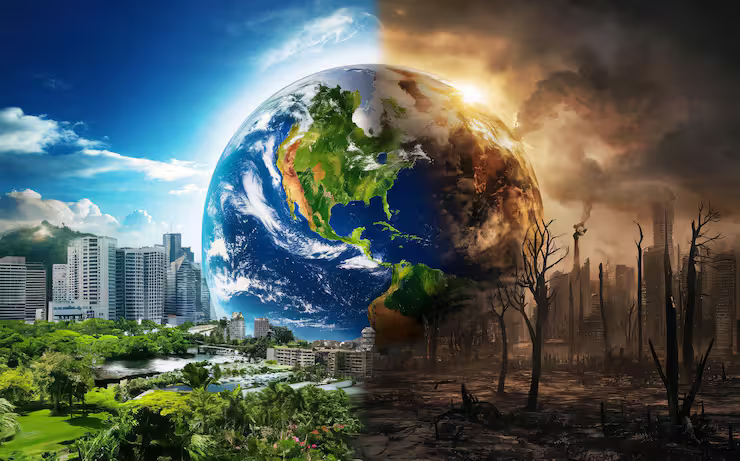
Recent trends include increased frequency of heatwaves, stronger storms, melting glaciers, and rising sea levels. These changes affect economies, ecosystems, and public health globally. Understanding the difference between climate change and global warming enables more precise discussions and informed decision-making, particularly as countries implement climate policies and sustainability initiatives.
Who It Affects and What Problems It Solves
Climate change and global warming affect nearly every sector of society, though the degree of impact varies by geography and economic resilience. Coastal communities face heightened risks from sea-level rise, while agricultural regions experience shifting rainfall patterns that disrupt food production. Urban populations encounter increased heat stress due to rising temperatures and the urban heat island effect.
Developing countries are often more vulnerable due to limited infrastructure and adaptive capacity. Meanwhile, industries such as agriculture, energy, insurance, and transportation are directly influenced by climate variability. Public health is also impacted, with rising temperatures contributing to heat-related illnesses and the spread of vector-borne diseases.
Problems It Helps Solve
Understanding the distinction between climate change and global warming helps address several critical challenges:
- Policy Precision: Differentiating the two enables targeted climate policies (e.g., emissions reduction vs. adaptation planning).
- Scientific Clarity: Improves communication of research findings and environmental risks.
- Risk Management: Helps businesses and governments prepare for both gradual warming and sudden climate events.
- Public Awareness: Encourages informed behavior changes and sustainable practices.
Recent Updates and Trends
Over the past year, climate-related developments have reinforced the urgency of addressing both global warming and broader climate change:
- Record Temperatures: 2025 was among the warmest years on record globally, continuing a decade-long warming trend.
- Extreme Weather Events: Increased frequency of floods, wildfires, and hurricanes has been observed across multiple continents.
- Policy Momentum: Countries have strengthened commitments under the Paris Agreement, aiming to limit warming to 1.5°C above pre-industrial levels.
- Renewable Energy Growth: Solar and wind energy adoption has accelerated, reducing reliance on fossil fuels.
- Carbon Markets Expansion: More nations are implementing carbon pricing mechanisms to curb emissions.
Scientific assessments from organizations like National Aeronautics and Space Administration confirm that greenhouse gas concentrations remain at historically high levels, emphasizing the need for both mitigation and adaptation strategies.
Climate Change vs Global Warming Comparison Table
| Aspect | Global Warming | Climate Change |
|---|---|---|
| Definition | Increase in Earth’s average temperature | Broad changes in climate patterns |
| Scope | Narrow (temperature-focused) | व्यापक (temperature, rainfall, storms, etc.) |
| Causes | Greenhouse gas emissions | Includes warming + natural variability |
| Examples | Rising global temperatures | Floods, droughts, sea-level rise |
| Measurement | Temperature data | Multiple indicators (temperature, precipitation, ice melt) |
| Timeframe | Long-term trend | Both short-term variability and long-term trends |
| Policy Focus | Emission reduction | Adaptation + mitigation strategies |
| Public Understanding | Often simplified concept | More complex and comprehensive |
Laws or Policies and Practical Guidance
Climate change and global warming are governed by a range of international, national, and regional policies. These frameworks aim to reduce emissions, promote sustainability, and enhance resilience.
Key Policies
- Paris Agreement: Sets global targets to limit temperature rise and encourages national climate action plans.
- National Climate Policies: Countries implement emission reduction targets, renewable energy incentives, and carbon taxes.
-
India’s Climate Initiatives:
- National Action Plan on Climate Change (NAPCC)
- Renewable energy targets (e.g., solar mission)
- Energy efficiency programs
Practical Guidance
-
For Individuals:
- Reduce energy consumption and adopt renewable sources where possible
- Use public transport or electric vehicles
- Support sustainable products
-
For Businesses:
- Conduct carbon footprint assessments
- Invest in energy-efficient technologies
- Align with ESG (Environmental, Social, Governance) frameworks
-
For Policymakers:
- Balance mitigation (reducing emissions) with adaptation (preparing for impacts)
- Strengthen climate resilience in infrastructure
Tools and Resources
Several tools and platforms help individuals and organizations understand and respond to climate change and global warming:
-
Climate Data Platforms:
- National Oceanic and Atmospheric Administration climate datasets
- NASA climate dashboards
-
Carbon Footprint Calculators:
- Online tools to estimate personal or organizational emissions
-
Renewable Energy Tools:
- Solar potential calculators
- Energy efficiency assessment tools
-
Educational Resources:
- IPCC reports
- Government climate portals
- Academic research databases
-
Mobile Apps:
- Apps for tracking energy usage and sustainability habits
These resources provide actionable insights and data-driven understanding, supporting informed decision-making.
Frequently Asked Questions (FAQ)
What is the main difference between climate change and global warming?
Global warming refers specifically to rising global temperatures, while climate change includes broader environmental changes such as precipitation shifts and extreme weather events.
Is global warming the cause of climate change?
Yes, global warming is a major driver of climate change, as increased temperatures influence weather patterns, sea levels, and ecosystems.
Why are these terms often used interchangeably?
They are closely related, and global warming is a key component of climate change, leading to confusion in general discussions.
How does climate change impact daily life?
It affects food supply, water availability, health risks, and infrastructure through extreme weather and environmental changes.
What can individuals do to help mitigate climate change?
Reducing energy consumption, using sustainable transport, and supporting renewable energy initiatives are effective steps.
Conclusion
Climate change and global warming are interconnected but distinct concepts. Global warming focuses on the rise in Earth’s temperature, while climate change encompasses a wider range of environmental transformations. Scientific data consistently shows that human activities, particularly greenhouse gas emissions, are the primary drivers of these changes.
Understanding the difference is crucial for developing effective strategies. While reducing emissions addresses global warming, adapting to environmental shifts is essential for managing climate change impacts. A combined approach—integrating mitigation, adaptation, and policy action—offers the most practical path forward.
From a data-driven perspective, addressing global warming is a foundational step in limiting broader climate disruptions. Therefore, prioritizing emission reduction alongside resilience planning is the most balanced and effective recommendation.