Water Jet Cutting Machines Overview Learn Working Principles, Facts, and Practical Knowledge
Water jet cutting machines are advanced material processing systems that use extremely high-pressure water streams to cut a wide range of materials. In many industrial environments, the water stream is combined with abrasive particles to improve cutting efficiency for hard surfaces such as metals, ceramics, and composites.
These machines exist to solve a long-standing challenge in manufacturing: how to cut materials precisely without generating heat-affected zones, micro-cracks, or structural distortion. Unlike thermal cutting methods, water jet cutting relies on kinetic energy rather than heat, preserving material integrity.
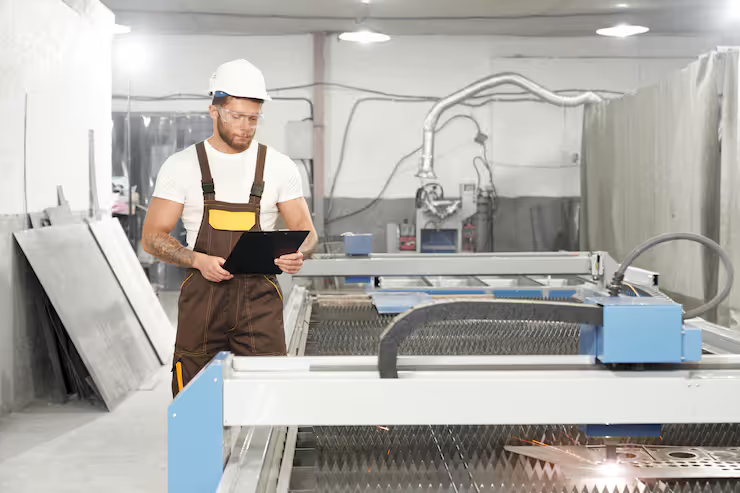
Industries that rely on precision manufacturing such as aerospace engineering, automotive component manufacturing, stone processing, and electronics fabrication use water jet cutting machines for their accuracy, flexibility, and material compatibility.
Why Water Jet Cutting Technology Matters in Modern Manufacturing
In today’s high-precision industrial landscape, manufacturers face increasing pressure to improve efficiency, accuracy, and sustainability. Water jet cutting technology addresses these demands by offering a non-thermal, environmentally controlled cutting solution.
Key reasons this technology is considered critical include:
-
Ability to cut heat-sensitive and laminated materials
-
Minimal material waste and narrow kerf width
-
Compatibility with metals, glass, rubber, composites, and plastics
-
Improved dimensional accuracy for complex geometries
Water jet cutting machines affect a wide range of stakeholders:
-
Manufacturing engineers focused on production accuracy
-
Quality control professionals responsible for material integrity
-
Industrial designers working with complex shapes
-
Research facilities testing advanced materials
The technology solves common manufacturing problems such as thermal deformation, secondary finishing requirements, and inconsistent edge quality.
Working Principles Explained with Practical Insight
At the core of every water jet cutting machine is an ultra-high-pressure pump that pressurizes water up to 60,000 PSI or more. This pressurized water is forced through a small orifice, creating a focused, high-velocity jet capable of cutting materials.
There are two primary operating methods:
Pure Water Jet Cutting
-
Used for soft materials like rubber, foam, textiles, and food-grade products
-
Relies solely on water pressure
Abrasive Water Jet Cutting
-
Abrasive particles such as garnet are mixed with the water stream
-
Suitable for metals, stone, glass, and composites
The cutting process is controlled through CNC software, allowing precise path control, repeatability, and automation.
Key Technical Components at a Glance
| Component | Function |
|---|---|
| High-Pressure Pump | Generates cutting pressure |
| Cutting Head | Directs water and abrasive stream |
| Abrasive Delivery System | Regulates abrasive flow |
| CNC Controller | Manages cutting paths |
| Catcher Tank | Absorbs jet energy after cutting |
Recent Industry Updates and Technology Trends
Over the past year, water jet cutting technology has continued to evolve, particularly in automation and efficiency optimization.
Notable developments observed since mid-2024 include:
-
Increased adoption of AI-assisted CNC programming for optimized tool paths
-
Enhanced pump efficiency designs focused on energy management
-
Improved abrasive recycling systems to reduce material waste
-
Integration with Industry 4.0 monitoring platforms for predictive maintenance
In late 2024, several industrial equipment expos highlighted multi-axis water jet systems capable of complex 3D cutting, reducing the need for secondary machining processes.
Regulatory Landscape and Policy Influence
Water jet cutting machines are influenced by industrial safety and environmental regulations, particularly in countries with strong manufacturing compliance frameworks such as India.
Relevant regulatory considerations include:
-
Occupational safety standards governing high-pressure equipment
-
Noise exposure limits in industrial environments
-
Wastewater management and filtration requirements
-
Abrasive disposal and recycling guidelines
In India, manufacturing facilities using high-pressure cutting equipment must align with guidelines issued under industrial safety acts and pollution control board recommendations. These regulations encourage safer machine design, proper training, and environmentally responsible operation.
Government initiatives promoting advanced manufacturing and precision engineering have also indirectly supported wider adoption of water jet cutting technology.
Tools, Software, and Knowledge Resources
Professionals working with water jet cutting machines often rely on specialized digital tools and technical resources to improve accuracy and efficiency.
Commonly used resources include:
-
CNC nesting and tool-path optimization software
-
Pressure and flow rate calculators for material thickness planning
-
Abrasive consumption estimation tools
-
Industry standards documentation for material processing
-
Technical whitepapers from manufacturing research institutes
These tools help engineers improve cut quality, manage consumables, and maintain consistent production output.
Performance Comparison with Other Cutting Technologies
| Feature | Water Jet Cutting | Laser Cutting | Plasma Cutting |
|---|---|---|---|
| Heat Affected Zone | None | Present | Significant |
| Material Range | Very Wide | Limited | Moderate |
| Edge Quality | High | Very High | Medium |
| Thickness Capability | High | Medium | High |
| Material Distortion | Minimal | Possible | Likely |
Frequently Asked Questions
What materials can water jet cutting machines handle?
Water jet cutting machines can process metals, stone, glass, ceramics, composites, rubber, plastics, and laminated materials without structural damage.
How accurate is water jet cutting compared to other methods?
Modern CNC-controlled water jet systems achieve high dimensional accuracy, often within tight tolerances suitable for precision engineering applications.
Does water jet cutting affect material strength?
Because the process is non-thermal, it does not alter material hardness, grain structure, or mechanical properties.
What industries commonly use this technology?
Aerospace, automotive manufacturing, electronics fabrication, architectural stone processing, and research laboratories widely use water jet cutting systems.
Is water jet cutting suitable for thick materials?
Yes, high-pressure abrasive water jet systems are effective for cutting thick and dense materials while maintaining edge quality.
Final Thoughts and Practical Takeaways
Water jet cutting machines represent a mature yet continually evolving technology that supports precision, versatility, and material integrity across industrial sectors. Their ability to cut diverse materials without heat damage positions them as a critical solution for modern manufacturing challenges.
As automation, digital control systems, and efficiency improvements continue to advance, water jet cutting technology is expected to remain a key component in high-accuracy production environments. Understanding its working principles, regulatory context, and practical applications allows professionals to make informed technical decisions grounded in real-world manufacturing needs.