Understanding Industrial Water Systems Basics, Functions, and Practical Insights for Modern Industries
Industrial water systems are structured frameworks used to source, treat, distribute, recycle, and discharge water within industrial environments. These systems support manufacturing processes, energy production, chemical processing, food and beverage operations, pharmaceuticals, textiles, mining, and heavy engineering.
Water plays multiple roles in industrial settings, including cooling, heating, washing, material transport, chemical reactions, and equipment protection. As industrial activity expanded globally, unmanaged water use began causing operational inefficiencies, environmental degradation, and regulatory conflicts. Industrial water systems evolved to ensure reliable water quality, process stability, and responsible water stewardship.
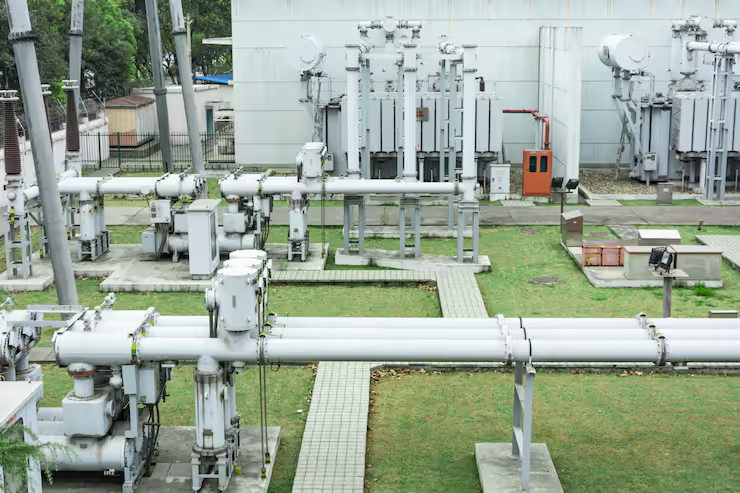
Modern industrial water management integrates engineering design, automation, data monitoring, and environmental compliance. Today’s systems are no longer isolated utilities but strategic infrastructure supporting productivity, sustainability, and risk management.
Importance: Why Industrial Water Systems Matter Today
Industrial water systems are critical due to rising water scarcity, stricter environmental regulations, and increasing industrial complexity. These systems directly influence operational continuity, environmental impact, and long-term resource availability.
Key reasons these systems matter include:
-
Process reliability – Stable water quality prevents scaling, corrosion, and fouling
-
Resource efficiency – Optimized reuse reduces freshwater dependency
-
Environmental protection – Controlled discharge limits pollution
-
Compliance readiness – Structured systems align with regulatory expectations
-
Risk reduction – Monitoring minimizes contamination and shutdown risks
Industries affected include manufacturing plants, power generation facilities, refineries, data centers, semiconductor fabrication units, and agro-processing operations. Without effective industrial water treatment and wastewater management systems, operations face performance losses, regulatory exposure, and reputational damage.
Industrial water systems also solve challenges such as inconsistent water supply, variable raw water quality, high thermal loads, and chemical imbalance in process loops.
Recent Updates: Trends and Developments in the Past Year
The past year has seen accelerated innovation in industrial water infrastructure, driven by sustainability goals and digital transformation.
2025 trends shaping industrial water systems include:
-
Advanced membrane technologies (2024–2025)
Increased adoption of ultrafiltration and reverse osmosis for high-purity process water. -
AI-powered water monitoring (late 2024)
Machine learning models now predict scaling, corrosion, and biofouling events. -
Zero Liquid Discharge (ZLD) expansion (2024)
More industries are implementing closed-loop water recycling frameworks. -
Digital twin modeling (2025)
Virtual replicas of water systems enable predictive optimization and fault detection. -
Decentralized treatment units (2024)
On-site modular treatment systems reduce load on centralized infrastructure.
These updates reflect a shift from reactive water management to predictive, data-driven control strategies focused on long-term water security.
Laws and Policies Affecting Industrial Water Systems
Industrial water systems operate within a framework of national and regional environmental regulations. In India, water governance has become increasingly structured and technology-focused.
Key regulatory influences include:
-
Water (Prevention and Control of Pollution) Act
Establishes discharge quality standards and monitoring obligations. -
Central Pollution Control Board (CPCB) guidelines
Define industrial effluent norms and reporting requirements. -
National Water Policy
Encourages water efficiency, reuse, and conservation in industrial sectors. -
State-level groundwater regulations
Control extraction limits and reporting for industrial water use. -
Environmental Impact Assessment (EIA) rules
Require water management planning for new industrial projects.
These policies influence system design, monitoring frequency, reporting accuracy, and technology selection. Compliance-focused water system architecture is now considered a core operational requirement rather than a peripheral function.
Tools and Resources Used in Industrial Water Management
Modern industrial water systems rely on specialized tools and platforms to ensure performance accuracy and regulatory alignment.
Commonly used tools and resources include:
-
Water balance modeling software
-
Online water quality parameter calculators
-
SCADA-based monitoring platforms
-
Industrial IoT sensors for flow, pressure, and conductivity
-
Cooling tower performance analysis dashboards
-
Effluent load estimation templates
-
Process water optimization frameworks
-
Digital compliance reporting portals
These resources support informed decision-making, predictive maintenance, and operational transparency across complex industrial environments.
Practical Components of Industrial Water Systems
Industrial water systems typically consist of interconnected subsystems, each serving a specific function.
| System Component | Primary Function |
|---|---|
| Raw water intake | Source abstraction and screening |
| Pretreatment | Removal of suspended solids |
| Process water treatment | Quality adjustment for operations |
| Cooling water systems | Thermal load management |
| Boiler water systems | Steam generation protection |
| Wastewater treatment | Effluent quality control |
| Water recycling units | Reuse and conservation |
| Discharge monitoring | Environmental compliance |
FAQs: Common Questions About Industrial Water Systems
What is the main objective of industrial water systems?
The primary objective is to ensure consistent water quality and availability for industrial processes while minimizing environmental impact and regulatory risk.
How do industrial water systems differ from municipal systems?
Industrial systems are process-specific, require higher quality control, and often include recycling and recovery mechanisms not found in municipal networks.
Why is water recycling important in industrial operations?
Recycling reduces freshwater dependency, stabilizes operations during supply variability, and supports long-term sustainability goals.
What risks arise from poorly managed industrial water systems?
Risks include equipment damage, process inefficiencies, regulatory non-compliance, environmental pollution, and operational downtime.
How often should industrial water systems be monitored?
Continuous monitoring is recommended for critical parameters, supported by periodic audits and performance reviews.
Conclusion: The Strategic Role of Industrial Water Systems
Industrial water systems are foundational to modern industrial operations. Beyond basic utility functions, they influence efficiency, environmental responsibility, regulatory alignment, and operational resilience.
As industries face increasing pressure from water scarcity, climate variability, and compliance expectations, well-designed industrial water treatment and management systems provide measurable strategic value. The future of industrial growth depends not only on production capacity but also on intelligent water stewardship supported by technology, policy awareness, and system integration.
Organizations that prioritize robust industrial water systems are better positioned for stability, adaptability, and sustainable progress in an increasingly resource-constrained world.