Petrochemical Mixing Units An Explore Guide with Basics, Explanation, and Key Facts
Petrochemical mixing units are engineered systems designed to blend liquids, gases, or semi-solid materials during chemical processing. These units play a central role in petrochemical plants by ensuring uniform composition, controlled reactions, and stable downstream processing.
In petrochemical operations, raw hydrocarbons, additives, catalysts, and intermediate compounds must be mixed accurately to maintain reaction efficiency. Mixing units exist to support chemical reactions, heat transfer, phase dispersion, and homogeneity within complex industrial processes.
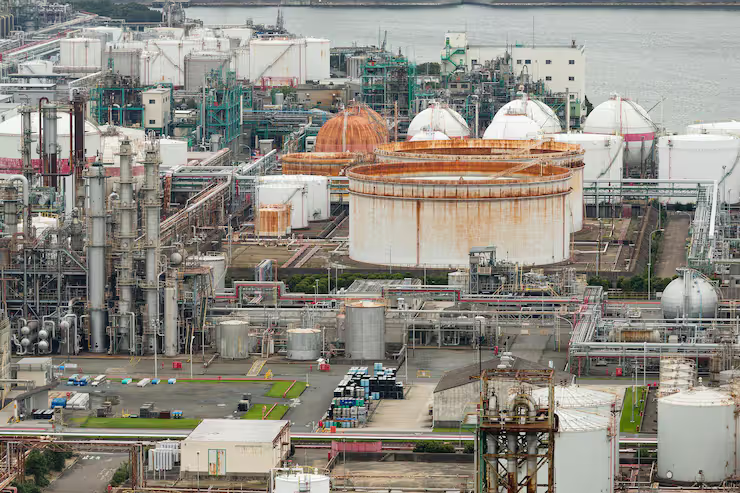
Unlike simple blending equipment, petrochemical mixing units are designed to operate under high pressure, elevated temperatures, and chemically aggressive environments. Their development is closely linked to the growth of modern refineries, polymer plants, and chemical manufacturing facilities.
Why Petrochemical Mixing Units Matter in Modern Industry
Petrochemical mixing units directly impact productivity, product consistency, and operational safety across the energy and chemical sectors. Even minor inconsistencies in mixing can lead to reaction instability, equipment fouling, or reduced material performance.
Industries affected include:
-
Refining and downstream petrochemical processing
-
Polymer and plastics manufacturing
-
Specialty chemical production
-
Energy and fuel processing facilities
Key problems these units help solve include:
-
Uneven concentration of reactants
-
Incomplete chemical reactions
-
Temperature gradients within reactors
-
Phase separation during processing
Effective mixing improves process efficiency, reduces waste generation, and enhances material quality. As petrochemical plants aim for higher output with lower environmental impact, optimized mixing has become a critical engineering focus.
Types of Petrochemical Mixing Units Explained
Petrochemical mixing units are generally categorized based on how energy is introduced into the system.
Dynamic Mixing Units
These units use mechanical motion to achieve mixing.
-
Agitated tanks with impellers
-
High-shear mixers for viscous materials
-
Turbine-based industrial mixers
Static Mixing Units
These units rely on internal structures without moving parts.
-
Inline static mixers
-
Helical and baffle-type mixers
-
Pipeline-integrated mixing elements
Hybrid Mixing Configurations
Used where both flow-induced and mechanical mixing are required, particularly in advanced chemical reactions.
Comparison Table: Static vs Dynamic Mixing Units
| Feature | Static Mixing Units | Dynamic Mixing Units |
|---|---|---|
| Moving parts | None | Present |
| Energy source | Fluid flow | Mechanical drive |
| Maintenance needs | Low | Moderate |
| Mixing intensity | Moderate | High |
| Typical applications | Continuous processes | Batch processing |
Recent Developments and Industry Trends
Over the past year, petrochemical mixing technology has evolved in response to efficiency and sustainability goals.
2024–2025 Industry Trends
-
Increased use of computational fluid dynamics (CFD) to model mixing behavior
-
Adoption of smart sensors for real-time mixing performance monitoring
-
Improved corrosion-resistant alloys for aggressive chemical environments
-
Design optimization for reduced pressure drop in static mixers
Digital process control integration has become more common, allowing operators to adjust mixing parameters dynamically based on process conditions. Advanced simulations now help reduce trial-and-error during plant design and upgrades.
Regulations and Policy Influence on Mixing Unit Design
Petrochemical mixing units are influenced by industrial safety, environmental, and operational regulations. These rules ensure that mixing systems operate safely and efficiently under regulated conditions.
Common regulatory considerations include:
-
Pressure vessel and mechanical integrity standards
-
Emission control requirements
-
Workplace safety compliance
-
Energy efficiency benchmarks
In countries with established petrochemical sectors, government programs increasingly promote:
-
Reduced energy consumption in process equipment
-
Improved chemical handling safety
-
Standardization of industrial equipment design
Compliance influences material selection, unit configuration, and inspection practices across petrochemical facilities.
Tools and Resources for Petrochemical Mixing Knowledge
Several technical tools and resources support understanding and optimization of petrochemical mixing units.
Engineering and Analysis Tools
-
Computational fluid dynamics simulation platforms
-
Process flow modeling software
-
Mixing efficiency calculators
-
Heat and mass transfer analysis tools
Reference Resources
-
Chemical engineering handbooks
-
Industry technical journals
-
Standards documentation from recognized engineering bodies
-
University research publications on fluid dynamics
Operational Aids
-
Mixing performance monitoring dashboards
-
Sensor-based flow and temperature tracking systems
-
Digital maintenance scheduling platforms
These resources help engineers evaluate mixing performance, predict outcomes, and improve process stability.
Operational Factors Affecting Mixing Performance
Several variables influence how effectively a mixing unit performs in petrochemical processes.
Key factors include:
-
Fluid viscosity and density
-
Flow rate and turbulence level
-
Mixer geometry and blade design
-
Temperature and pressure conditions
Even small design adjustments can significantly affect dispersion quality and reaction uniformity. This is why mixing units are often customized for specific process requirements rather than standardized across all applications.
Common FAQs About Petrochemical Mixing Units
What is the primary function of a petrochemical mixing unit?
The main function is to ensure uniform distribution of chemical components to support controlled reactions and stable processing conditions.
How do static mixers differ from agitated mixers?
Static mixers rely on internal structures and flow energy, while agitated mixers use mechanical motion to blend materials.
Why is precise mixing important in petrochemical processing?
Precise mixing prevents reaction inefficiencies, product variability, and operational instability.
Are mixing units designed differently for liquids and gases?
Yes. Gas-phase mixing focuses on flow dynamics, while liquid mixing often emphasizes shear force and viscosity management.
How does mixing efficiency affect environmental performance?
Efficient mixing reduces waste, improves reaction completeness, and lowers excess energy usage.
Key Facts and Technical Insights
-
Mixing efficiency directly influences reaction yield and product consistency
-
Poor mixing can lead to localized overheating or catalyst degradation
-
Advanced modeling tools now allow virtual testing before physical installation
-
Material compatibility is critical due to aggressive chemical exposure
-
Proper mixing reduces downstream processing complications
Concluding Insights on Petrochemical Mixing Units
Petrochemical mixing units are foundational to modern chemical and energy processing systems. Their role extends beyond simple blending, influencing reaction control, energy efficiency, and operational safety.
As petrochemical facilities adopt smarter technologies and stricter regulatory standards, mixing unit design continues to evolve. Understanding the basics, operational principles, and recent developments helps engineers, researchers, and industry stakeholders make informed technical decisions.
With ongoing innovation in simulation, materials, and process control, petrochemical mixing units will remain a key component in advancing efficient and responsible industrial production.