Laser Welding Machines Comparison Guide: Insights, Basics, and Practical Knowledge
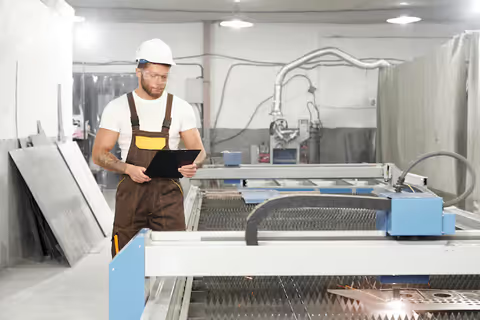
Laser welding machines are advanced manufacturing tools that use a concentrated beam of light (laser) to join materials, typically metals and thermoplastics, with high precision and minimal heat distortion. Unlike traditional welding techniques such as MIG or TIG welding, laser welding offers enhanced control, speed, and automation compatibility, making it a preferred choice in industries like automotive, aerospace, electronics, and medical device manufacturing.
In recent years, the comparison between different types of laser welding machines—such as fiber laser, CO₂ laser, and diode laser systems—has become increasingly important. This is largely due to rapid advancements in manufacturing technologies, Industry 4.0 integration, and the growing demand for high-quality, repeatable welds. Additionally, businesses are focusing on energy efficiency, operational costs, and adaptability, which further drives the need to evaluate different machine types.
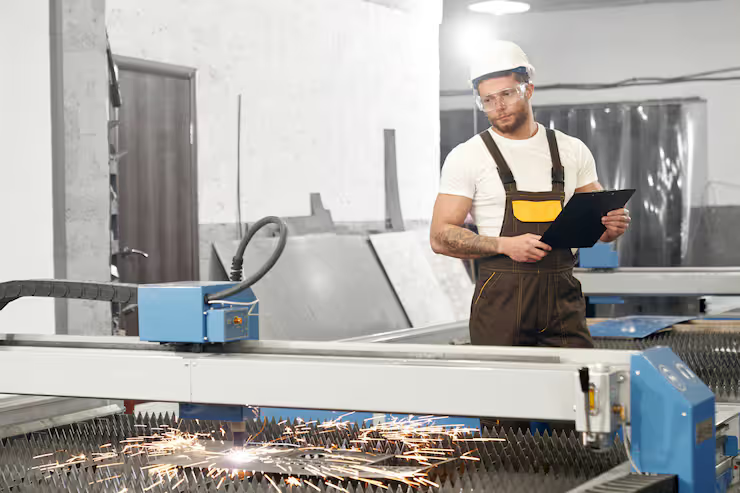
Trends such as automation, AI-assisted welding, and compact handheld laser welders are reshaping the industry landscape. These innovations are not only improving productivity but also making laser welding more accessible to small and medium enterprises. Understanding the differences between machine types helps stakeholders make informed decisions aligned with production goals and budget constraints.
Who It Affects and What Problems It Solves
Laser welding machines impact a wide range of industries and professionals. Manufacturers in sectors like automotive, electronics, jewelry, and medical equipment rely heavily on precision welding to maintain product quality. Engineers, production managers, and fabrication specialists benefit from laser welding due to its ability to deliver consistent results with minimal manual intervention.
Small-scale workshops and startups are also increasingly adopting compact laser welding systems to enhance efficiency without requiring extensive infrastructure. Additionally, research institutions and prototyping labs use these machines for experimental and custom fabrication tasks.
Problems It Solves
Laser welding addresses several limitations found in traditional welding methods:
- Precision Issues: Laser welding enables micron-level accuracy, reducing defects.
- Heat Distortion: Minimal heat-affected zones prevent material warping.
- Speed Constraints: High welding speeds improve production throughput.
- Material Compatibility: Ability to weld thin, delicate, or dissimilar materials.
- Automation Challenges: Easily integrates with robotic systems and CNC machines.
By solving these issues, laser welding improves both product quality and operational efficiency across industries.
Recent Updates and Industry Trends
Over the past year, the laser welding industry has seen notable advancements driven by technological innovation and market demand:
- Rise of Handheld Laser Welders: Portable systems are gaining popularity due to ease of use and reduced training requirements. These are particularly useful for repair and on-site applications.
- AI and Machine Learning Integration: Smart systems now monitor weld quality in real-time, adjusting parameters automatically to reduce defects.
- Energy Efficiency Improvements: New fiber laser systems consume significantly less power compared to older CO₂ systems, aligning with sustainability goals.
- Hybrid Welding Techniques: Combining laser welding with arc welding (laser-arc hybrid welding) enhances penetration depth and weld strength.
- Miniaturization in Electronics: Demand for micro-welding in electronics and battery manufacturing has increased, especially with the growth of electric vehicles.
- Supply Chain Localization: Manufacturers are investing in local production capabilities, increasing demand for flexible and scalable welding solutions.
These trends highlight a shift toward smarter, more efficient, and versatile welding technologies.
Comparison Table: Types of Laser Welding Machines
| Feature | Fiber Laser Welding | CO₂ Laser Welding | Diode Laser Welding |
|---|---|---|---|
| Wavelength | ~1.06 µm | ~10.6 µm | 0.8–1 µm |
| Efficiency | High (30–50%) | Moderate (10–20%) | Moderate to High |
| Maintenance | Low | High | Moderate |
| Material Compatibility | Metals, reflective metals | Non-metals, some metals | Plastics, thin metals |
| Speed | Very High | Moderate | Moderate |
| Cost (Initial) | High | Moderate | Lower |
| Automation Integration | Excellent | Limited | Good |
| Typical Applications | Automotive, aerospace | Textile, packaging | Medical, electronics |
| Portability | Available (handheld) | Rare | Compact systems available |
This comparison highlights that fiber laser welding machines are generally preferred for industrial applications due to their efficiency and versatility, while diode and CO₂ systems serve niche or specialized purposes.
Laws or Policies and Practical Guidance
Laser welding machines are subject to various safety regulations and standards, which vary by country but generally align with international guidelines.
Regulatory Framework
- Laser Safety Standards: Most countries follow IEC 60825 standards, which classify laser devices based on their hazard levels.
- Workplace Safety Regulations: Employers must ensure proper shielding, protective eyewear, and training for operators.
- Environmental Compliance: Regulations may govern emissions, energy consumption, and waste management.
- Certification Requirements: Machines often require CE marking (Europe) or equivalent certifications to ensure compliance.
In India, regulatory oversight may involve agencies such as the Bureau of Indian Standards (BIS) and adherence to occupational safety norms under labor laws.
Practical Guidance
- Industrial Use: Fiber lasers are recommended for high-volume, automated production environments.
- Small Workshops: Handheld fiber or diode lasers offer flexibility and lower setup complexity.
- Specialized Applications: CO₂ lasers may still be suitable for non-metal materials or specific industrial processes.
Choosing the right machine depends on compliance requirements, application type, and operational scale.
Tools and Resources
To effectively evaluate and implement laser welding systems, several tools and resources can be useful:
- Simulation Software: Tools like welding simulation platforms help predict weld quality and optimize parameters.
- CAD/CAM Integration: Software such as AutoCAD or SolidWorks supports design-to-production workflows.
- Online Calculators: Laser power and weld depth calculators assist in selecting appropriate machine specifications.
- Training Platforms: Online courses and certification programs provide operator training and safety education.
- Industry Reports: Market research reports offer insights into trends, pricing, and technology adoption.
- Maintenance Tools: Diagnostic software and predictive maintenance systems help reduce downtime.
These resources support informed decision-making and efficient machine operation.
Frequently Asked Questions (FAQ)
What is the main advantage of laser welding over traditional methods?
Laser welding offers higher precision, faster processing speeds, and minimal heat distortion, making it suitable for complex and delicate applications.
Which type of laser welding machine is best for metal fabrication?
Fiber laser welding machines are generally the most effective for metal fabrication due to their high efficiency and compatibility with reflective metals.
Are laser welding machines safe to use?
Yes, when proper safety protocols are followed, including the use of protective gear and compliance with safety standards.
Can laser welding be automated?
Yes, laser welding systems are highly compatible with automation and robotics, making them ideal for mass production.
What factors should be considered when choosing a laser welding machine?
Key factors include material type, production volume, budget, maintenance requirements, and integration capabilities.
Conclusion
Laser welding machines represent a significant advancement in manufacturing technology, offering precision, efficiency, and adaptability across various industries. Among the different types, fiber laser welding machines stand out for their high performance, energy efficiency, and suitability for automation. However, diode and CO₂ lasers continue to play important roles in specialized applications.
Data from industry adoption trends indicates a growing preference for fiber laser systems, particularly in sectors requiring high-speed and high-precision welding. The increasing integration of AI and automation further enhances the value proposition of these machines.
Ultimately, the choice of a laser welding machine should be guided by specific application needs, regulatory compliance, and long-term operational goals. For most industrial use cases, fiber laser welding provides the most balanced combination of performance and scalability, while smaller operations may benefit from compact or handheld alternatives.