Exploring Laser Welding Machines Overview, Working Principles, and Practical Insights
Laser welding machines are advanced industrial systems that join materials using a highly focused laser beam. The technology exists to deliver precise, controlled heat energy to a small area, allowing materials most commonly metals to fuse together with minimal distortion. Unlike traditional welding methods that rely on physical electrodes or filler-based heat transfer, laser welding uses concentrated photon energy.
The origin of laser welding can be traced back to the development of laser technology in the mid-20th century. As industries demanded higher precision, faster production cycles, and improved joint quality, laser-based material processing gained attention. Today, laser welding machines are widely studied in manufacturing engineering, automation design, and industrial fabrication research.
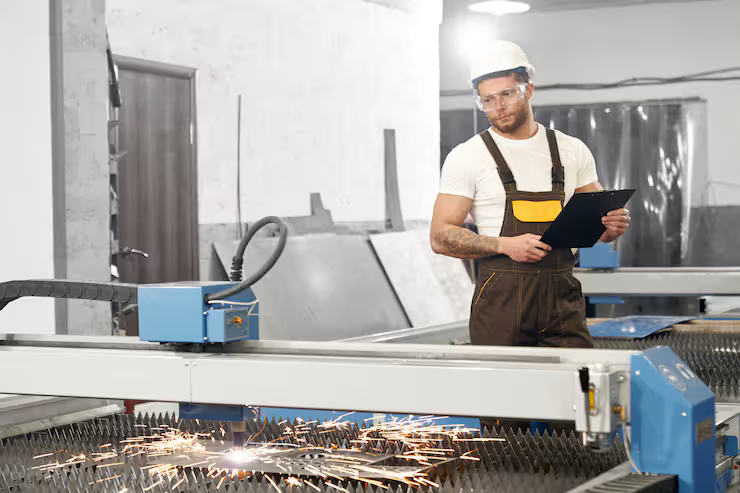
This technology is designed to address challenges such as heat-affected zones, joint inconsistency, and limited control in complex assemblies. Its relevance continues to grow as industrial systems shift toward digital manufacturing and high-accuracy production environments.
Importance: Why Laser Welding Technology Matters Today
Laser welding machines play a critical role in modern industrial ecosystems. Their importance lies in how they improve production efficiency, quality control, and material integrity across multiple sectors.
Industries and professionals influenced by laser welding technology include:
-
Manufacturing engineers
-
Industrial automation designers
-
Quality control specialists
-
Mechanical and materials researchers
-
Production planners
Key industrial challenges addressed by laser welding machines include:
-
Precision joining of thin or delicate materials
-
Reduced thermal distortion in high-strength alloys
-
Compatibility with automated and robotic systems
-
Consistent weld quality across large production volumes
In sectors such as automotive manufacturing, electronics assembly, aerospace structures, and medical device fabrication, laser welding technology enables designs that are difficult or impossible with conventional joining techniques. The ability to weld complex geometries with minimal post-processing is especially valuable in high-tolerance applications.
From a productivity standpoint, laser welding supports faster cycle times and improved repeatability. These factors directly influence operational efficiency and long-term manufacturing reliability.
Recent Updates: Trends and Developments in Laser Welding Technology (2024–2025)
Over the past year, laser welding machines have seen notable technological advancements and adoption trends.
One major development in 2024 has been the increased use of fiber laser sources with higher beam stability and energy efficiency. These systems offer improved performance consistency and lower maintenance requirements compared to older laser types.
Another important trend observed in late 2024 is the integration of artificial intelligence-based weld monitoring. Machine vision and real-time sensor feedback are increasingly used to detect weld defects, beam misalignment, and material inconsistencies during operation.
In early 2025, research publications highlighted the growth of remote laser welding techniques. This approach allows laser welding to be performed at a distance using scanning optics, reducing tool wear and increasing production flexibility in automated lines.
Emerging areas of focus include:
-
Digital twin modeling for laser welding processes
-
Real-time thermal simulation during welding
-
Hybrid laser welding combined with arc-based systems
These updates reflect the broader trend of smart manufacturing and data-driven industrial processes.
Laws or Policies: Regulatory Framework Affecting Laser Welding Machines
Laser welding machines are subject to various safety, environmental, and industrial compliance regulations depending on the country of operation.
In many regions, including India, the European Union, and North America, laser welding equipment must comply with laser safety classifications defined by international standards such as IEC and ISO frameworks. These regulations govern permissible exposure limits, machine enclosure requirements, and operator safety controls.
Workplace safety policies often require:
-
Proper laser hazard labeling
-
Enclosed welding cells or protective barriers
-
Mandatory operator training and certification
-
Compliance with occupational safety norms
Environmental regulations may also influence laser welding adoption, as laser-based joining typically generates fewer emissions and consumables compared to traditional welding processes.
Government-led industrial modernization programs, especially those promoting advanced manufacturing and automation, indirectly support the use of laser welding technology by encouraging high-precision and energy-efficient production systems.
Tools and Resources: Practical Support for Laser Welding Knowledge
Several technical tools and informational resources support learning, analysis, and implementation of laser welding systems.
Helpful resources include:
-
Laser welding process simulation software
-
Material compatibility charts for laser joining
-
Weld penetration depth calculators
-
Industrial safety compliance checklists
-
Academic journals on laser material processing
Commonly referenced tools and platforms:
| Resource Type | Purpose |
|---|---|
| Process simulation tools | Visualize heat flow and weld geometry |
| Optical beam analyzers | Measure laser focus and intensity |
| Thermal modeling software | Predict heat-affected zones |
| Technical standards databases | Access laser safety and compliance guidelines |
These resources are widely used by engineers, researchers, and manufacturing planners to improve process understanding and decision-making.
FAQs: Common Questions About Laser Welding Machines
What materials can be joined using laser welding machines?
Laser welding machines are commonly used for metals such as stainless steel, aluminum, titanium, and certain alloys. Some plastics can also be joined using specialized laser techniques.
How does laser welding differ from traditional welding methods?
Laser welding uses focused light energy instead of direct electrical arcs or electrodes. This allows for higher precision, narrower weld seams, and reduced thermal impact on surrounding material.
Is laser welding suitable for automated production lines?
Yes. Laser welding machines are highly compatible with robotic systems and automated manufacturing environments due to their repeatability and digital control capabilities.
What factors influence weld quality in laser welding?
Key factors include laser power, beam focus, welding speed, material thickness, and surface preparation. Process monitoring systems also play an important role.
Are laser welding machines energy efficient?
Modern fiber laser systems are considered energy efficient compared to older laser technologies, especially when optimized for specific industrial applications.
Conclusion: The Evolving Role of Laser Welding Machines
Laser welding machines represent a significant advancement in material joining technology. Their ability to deliver precision, consistency, and integration with digital manufacturing systems makes them a valuable component of modern industrial operations.
As manufacturing continues to move toward automation, data-driven optimization, and high-performance materials, laser welding technology is expected to remain a key area of innovation. Ongoing improvements in laser sources, process monitoring, and simulation tools are expanding the practical possibilities of this technology.
For engineers, researchers, and industrial planners, understanding laser welding machines is essential for navigating the future of advanced manufacturing and precision engineering.