Exploring EV Battery Pack Assembly Lines Overview, Design Principles, and Manufacturing Knowledge
Electric vehicle battery pack assembly lines are specialized manufacturing systems designed to integrate battery cells into safe, reliable, and high-performance energy storage units for electric vehicles. These assembly lines bring together electrochemical components, mechanical structures, thermal systems, and electronic controls into a single functional battery pack.
The rapid transition from internal combustion engines to electric mobility created the need for highly controlled, scalable, and repeatable battery manufacturing processes. Battery pack assembly lines exist to ensure consistency, safety, and compliance while handling complex lithium-ion components that are sensitive to contamination, temperature variation, and mechanical stress.
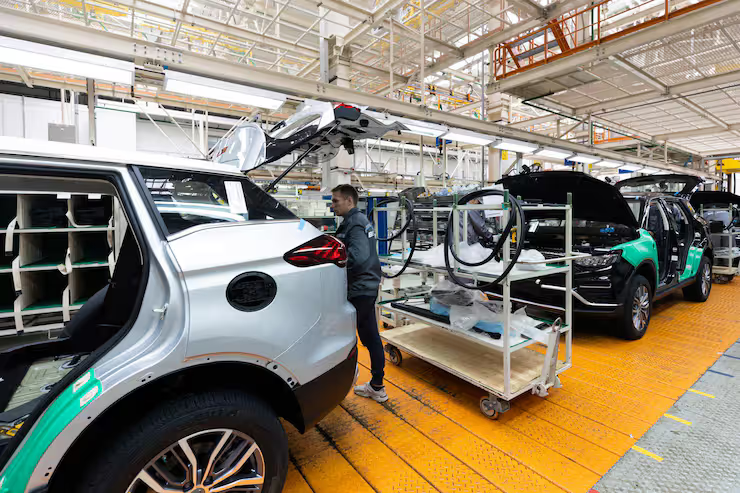
At their core, these production lines bridge the gap between individual battery cells and complete electric vehicle energy systems, enabling mass production without compromising quality or reliability.
Importance: Why EV Battery Pack Assembly Matters Today
The performance, safety, and lifespan of an electric vehicle are directly influenced by the quality of its battery pack assembly. As electric mobility adoption accelerates, the reliability of battery assembly lines has become a critical factor for manufacturers, regulators, and end users.
Key reasons these assembly lines matter include:
-
Ensuring consistent electrical performance across battery modules
-
Reducing the risk of thermal runaway and electrical faults
-
Supporting high-energy-density battery architectures
-
Enabling scalable EV production volumes
-
Improving traceability and quality assurance
Battery pack assembly lines affect a wide ecosystem, including automotive manufacturers, battery cell producers, equipment integrators, safety regulators, and infrastructure planners. These systems solve challenges related to energy density management, mechanical stability, thermal control, and electronic monitoring under real-world operating conditions.
From a manufacturing knowledge perspective, optimized assembly lines reduce defect rates, enhance process repeatability, and support advanced battery chemistries used in modern electric vehicles.
Design Principles Behind EV Battery Pack Assembly Lines
EV battery pack assembly lines are engineered around precision, automation, and safety. Each design choice reflects the sensitive nature of lithium-ion cells and the high reliability requirements of automotive applications.
Core design principles include:
-
Modular line architecture for flexibility and scalability
-
Automated cell handling to minimize contamination
-
Precision welding for electrical interconnections
-
Controlled environments for humidity and particulate management
-
Integrated testing at multiple production stages
Typical Assembly Line Flow
| Process Stage | Function |
|---|---|
| Cell sorting and grading | Ensures uniform capacity and impedance |
| Module assembly | Groups cells into electrically balanced units |
| Welding and interconnection | Establishes stable electrical pathways |
| Thermal system integration | Controls heat dissipation |
| Battery management system installation | Enables monitoring and control |
| End-of-line testing | Verifies electrical, thermal, and safety parameters |
Each stage incorporates sensors, data capture systems, and automated quality checks to maintain process integrity.
Recent Updates and Industry Trends (2025)
Over the past year, EV battery pack assembly lines have evolved rapidly in response to technological advancements and production scale requirements.
Notable developments include:
-
January 2025: Increased adoption of cell-to-pack architectures reducing module count
-
March 2025: Expansion of digital twin modeling for assembly line optimization
-
June 2025: Wider use of AI-driven defect detection in welding and sealing processes
-
August 2025: Growth of high-voltage battery pack designs exceeding 800V platforms
-
October 2025: Integration of inline X-ray inspection for internal weld verification
Manufacturers are also focusing on flexible tooling systems that support multiple battery formats without extensive reconfiguration. This shift reflects the industry’s need to adapt quickly to changing vehicle platforms and battery chemistries.
Laws, Regulations, and Government Programs (India)
In India, EV battery pack assembly lines operate under a framework of safety, quality, and localization policies.
Key regulatory influences include:
-
Automotive safety standards aligned with AIS and ISO norms
-
Electrical safety requirements for high-voltage systems
-
Environmental compliance for battery manufacturing processes
-
Localization incentives under national electric mobility programs
-
Traceability and labeling requirements for battery components
Government initiatives supporting domestic battery manufacturing encourage standardized assembly practices, improved quality control, and data transparency. These regulations directly shape line design, documentation practices, and validation protocols used in EV battery pack assembly facilities.
Tools and Resources for EV Battery Pack Assembly Knowledge
Several technical tools and digital resources support the planning, optimization, and monitoring of battery pack assembly lines.
Commonly used tools and platforms include:
-
Manufacturing execution systems for real-time production tracking
-
Battery pack design simulation software
-
Thermal modeling and validation tools
-
Inline electrical testing and impedance analysis systems
-
Process capability and statistical quality control dashboards
Example Metrics Monitored on Assembly Lines
| Parameter | Purpose |
|---|---|
| Weld resistance | Electrical integrity validation |
| Pack voltage consistency | Performance verification |
| Insulation resistance | Safety compliance |
| Temperature distribution | Thermal management assessment |
FAQs About EV Battery Pack Assembly Lines
What is the primary function of an EV battery pack assembly line?
Its primary function is to integrate battery cells, modules, thermal systems, and electronic controls into a complete, tested battery pack suitable for vehicle installation.
Why is automation essential in battery pack assembly?
Automation reduces contamination risks, improves precision, and ensures consistent quality when handling sensitive lithium-ion components.
How is safety ensured during battery pack assembly?
Safety is maintained through controlled environments, electrical isolation testing, thermal monitoring, and multiple inspection checkpoints.
What role does the battery management system play?
The battery management system monitors voltage, temperature, and current to protect the battery pack and optimize performance.
How does assembly quality affect battery lifespan?
Poor assembly quality can lead to uneven cell loading, heat buildup, and premature degradation, reducing overall battery life.
Conclusion: Advancing EV Manufacturing Through Battery Pack Assembly Excellence
EV battery pack assembly lines form the backbone of modern electric vehicle manufacturing. Their design, operation, and continuous improvement directly influence vehicle performance, safety, and durability.
As battery technologies evolve and production volumes increase, assembly lines are becoming more intelligent, data-driven, and adaptable. A deep understanding of assembly principles, regulatory frameworks, and recent advancements enables manufacturers and engineers to build resilient systems that support the future of electric mobility.
With precision engineering and informed manufacturing knowledge, EV battery pack assembly lines will continue to play a defining role in the global transition toward electrified transportation.