EV Battery Management Systems Comparison Guide: Insights, Basics, Tips & Practical Knowledge
Electric Vehicle (EV) Battery Management Systems (BMS) are critical electronic systems that monitor, protect, and optimize the performance of battery packs used in electric vehicles. A BMS ensures safe operation by controlling parameters such as voltage, current, temperature, and state of charge (SoC). As EV adoption accelerates globally, the importance of efficient and reliable BMS solutions has grown significantly.
In recent years, advancements in EV technology—such as fast charging, longer battery life expectations, and higher energy density—have increased the complexity of battery systems. This has made BMS design a key differentiator among EV manufacturers. Modern BMS solutions now incorporate predictive analytics, cloud connectivity, and AI-based diagnostics to improve safety and performance..
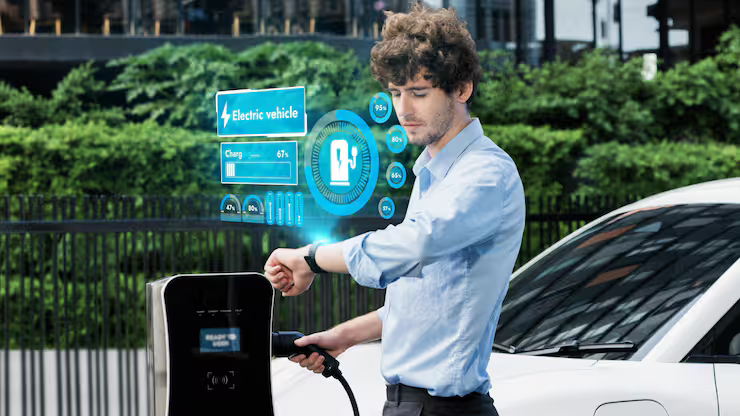
The comparison of different BMS types and technologies matters because it directly impacts vehicle range, safety, cost, and lifespan. With governments pushing electrification and stricter safety regulations, BMS innovation is becoming central to the EV ecosystem. Understanding these systems helps stakeholders—from engineers to policymakers and general users—make informed decisions in a rapidly evolving market.
Who It Affects and What Problems It Solves
Battery Management Systems affect a wide range of stakeholders, including EV manufacturers, battery suppliers, fleet operators, policymakers, and end users. For manufacturers, BMS determines how efficiently a battery performs and how safely it operates under various conditions. Fleet operators rely on BMS data to manage large-scale vehicle performance and maintenance schedules. Consumers benefit from improved battery lifespan, safety, and range accuracy.
In the broader ecosystem, BMS also plays a role in energy infrastructure. With the rise of vehicle-to-grid (V2G) systems, BMS helps manage energy flow between EVs and power grids, supporting renewable energy integration.
Problems It Solves
- Battery Safety Risks: Prevents overcharging, overheating, and short circuits
- Performance Optimization: Ensures uniform cell usage and efficient energy distribution
- Battery Degradation: Extends lifespan by maintaining optimal operating conditions
- Range Prediction Accuracy: Provides reliable state-of-charge and state-of-health data
- Thermal Management Challenges: Maintains temperature balance across cells
- Fault Detection: Identifies early signs of battery failure
Without a BMS, EV batteries would face higher risks of failure, reduced efficiency, and safety hazards.
Recent Updates and Trends (Past Year)
The past year has seen notable advancements in EV Battery Management Systems:
- AI-Driven BMS: Machine learning algorithms are increasingly used to predict battery degradation and optimize charging cycles.
- Wireless BMS (wBMS): Adoption of wireless communication between battery cells reduces wiring complexity and weight, improving efficiency.
- Cloud-Connected Systems: Real-time monitoring and over-the-air (OTA) updates are becoming standard in advanced EV platforms.
- Solid-State Battery Integration: Emerging battery chemistries require more sophisticated BMS to handle different voltage and thermal characteristics.
- Enhanced Cybersecurity: As BMS becomes connected, protecting data and system integrity is a growing priority.
- Fast Charging Optimization: New algorithms help balance rapid charging with battery health preservation.
Industry reports suggest that BMS technology is evolving alongside EV adoption, with a focus on safety, scalability, and data intelligence rather than just monitoring functions.
Comparison Table: Types of EV Battery Management Systems
| Feature | Centralized BMS | Distributed BMS | Modular BMS | Wireless BMS |
|---|---|---|---|---|
| Architecture | Single control unit | Multiple controllers | Group-based modules | Wireless communication |
| Wiring Complexity | High | Moderate | Moderate | Low |
| Scalability | Limited | High | High | Very High |
| Cost | Lower initial cost | Moderate | Moderate | Higher initially |
| Reliability | Lower (single point failure) | Higher | High | High |
| Maintenance | Complex | Easier | Easier | Simplified |
| Data Accuracy | Moderate | High | High | Very High |
| Weight Impact | Higher | Moderate | Moderate | Lower |
| Use Case | Small EVs | Medium EVs | Large EVs | Advanced EV platforms |
Key Insight
- Centralized systems are simpler but less scalable.
- Distributed and modular systems provide better fault tolerance.
- Wireless BMS is emerging as a future-ready solution due to reduced wiring and improved flexibility.
Laws and Policies Affecting EV Battery Management Systems
Government regulations and policies significantly influence BMS design and implementation, especially in countries like India.
Key Regulatory Areas
- Battery Safety Standards: Regulations mandate protection against thermal runaway and electrical faults.
- AIS-156 (India): Specifies safety requirements for EV battery systems, including BMS functionality.
- FAME II Scheme (India): Encourages EV adoption, indirectly promoting advanced battery systems.
- UN 38.3 Certification: Required for battery transport safety.
- Recycling Policies: BMS must support battery lifecycle tracking for compliance with recycling norms.
Practical Guidance
- For Manufacturers: Choose modular or distributed BMS to meet safety compliance and scalability needs.
- For Fleet Operators: Opt for cloud-connected BMS for monitoring and regulatory reporting.
- For Consumers: Vehicles with advanced BMS typically offer better safety and battery longevity.
Policies are increasingly pushing for transparency, safety, and sustainability, making BMS a compliance-critical component.
Tools and Resources
Several tools and platforms support the development, analysis, and monitoring of EV Battery Management Systems:
Software Tools
- MATLAB/Simulink for battery modeling and simulation
- ANSYS for thermal analysis
- LabVIEW for system testing and validation
Monitoring Platforms
- Cloud-based dashboards for real-time battery data
- IoT-enabled BMS platforms for fleet management
Calculators and Utilities
- Battery life estimation calculators
- State-of-charge prediction tools
- Thermal performance analysis tools
Learning Resources
- Research papers on battery technologies
- Government EV policy portals
- Industry whitepapers and technical documentation
Templates and Frameworks
- BMS design architecture templates
- Safety compliance checklists
- Battery testing protocols
These tools help engineers, analysts, and researchers design more efficient and compliant BMS systems.
Frequently Asked Questions (FAQ)
What is the main function of an EV Battery Management System?
A BMS monitors and controls battery parameters like voltage, temperature, and charge to ensure safety and efficiency.
Why is BMS important in electric vehicles?
It prevents battery damage, improves performance, and ensures safe operation under various conditions.
What is the difference between centralized and distributed BMS?
Centralized BMS uses a single controller, while distributed BMS uses multiple controllers for better scalability and reliability.
How does BMS improve battery life?
By maintaining optimal charging cycles and temperature conditions, it reduces degradation over time.
Are wireless BMS systems better than traditional ones?
Wireless BMS offers advantages like reduced wiring, improved scalability, and easier maintenance, but may have higher initial costs.
Conclusion
EV Battery Management Systems are foundational to the performance, safety, and longevity of electric vehicles. As EV adoption grows, the role of BMS has expanded from basic monitoring to intelligent system optimization. Data-driven advancements such as AI integration, wireless communication, and cloud connectivity are reshaping how batteries are managed.
Comparative analysis shows that while centralized BMS may suit smaller applications, distributed, modular, and wireless systems provide greater scalability, reliability, and future readiness. Regulatory frameworks further emphasize the need for advanced BMS designs that meet safety and sustainability standards.
From a practical standpoint, selecting the right BMS depends on the application: smaller EVs may prioritize cost efficiency, while large-scale or commercial applications benefit from advanced, scalable systems.
Overall, the trend clearly points toward intelligent, connected, and modular BMS solutions as the most effective approach for modern electric mobility.